Showing posts with label Investing. Show all posts

REI: Getting Out of a REI Deal

Contract Contingencies or "loopholes" can help you get out of a bad deal.
This week I am going to go over how you can be protected by contingency clauses in your purchase agreement contract, specifically from an investment perspective.

Purchase Agreement Loopholes

When you sign a standard real estate purchase agreement, you have the option to include contingencies, to protect you and allow you to get out of the agreement. You can include a financing contingency, (if you need to get approved for financing), a title contingency, (in the event the title is not “clear”, in merchantable condition, and the seller cannot remedy it), sale of another property, appraisal price being equal to or greater than the sale price, no issues found during an inspection period, or pretty much any other contingency you would like to include.

The key thing to remember is that the seller has to accept these contingencies. The specific ones listed above are standard contingencies and sellers are used to seeing them. As a real estate investor, you should know that the number of contingencies could possibly affect the seller’s decision to accept your offer if there is a similar offer for the property with less contingencies.

The main contingencies to include are the inspection period and clear title.

You should have your financing in place already, to make the deal go smoothly. This can be personal cash, private money, hard money, or being pre-qualified for a loan from a traditional lending institution.

In selecting your properties, you should have a pretty good idea of the market value of the property and in pursuing the target property, have negotiated a sale price that is discounted from market price, allowing you to cover expenses and cash flow.

Utilizing a Contingency

A couple of weeks ago, I posted about making an offer on an REO property. I was excited for the opportunity to acquire this property because it was in the same neighborhood as the last property we acquired and had a couple of more amenities.

We were at the point of waiting for the asset manager to respond with the final signed contract so we could start the inspection period. We waited and waited…but did not hear anything for a whole week.
We were told to expect up to a seven day wait for a response, but when we finally did get a response on the ninth day after we submitted contract signatures, the asset manager had signed the contract two days after we submitted it. This left us with approximately two and a half days for inspections, title search, etc., and late on a Friday morning. There was no way we would have been able to get the title search completed at that point.

We exercised the contingency and canceled the contract.

Because of issues like this, I am glad I had the option to exit the deal. Some investors may not worry about the title, but I do. I have run into title issues in the past that made it hard for me to sell a property, so I wanted to be sure that the title was clear. Especially with the property being an REO property.

With it having been through a Sheriff’s Sale, the title “should” be cleared of all liens, but if a lienholder was not notified that the property was going up for Sheriff’s Sale, then their lien is still in effect.

I could have run the title search before getting confirmation that we had a contract in place but did not want to spend $500 and not be able to get the property under contract.

So, on with the property search!

Oh, if you are in the Houma/Thibodaux area and have property you need to sell, get in touch with me.

And, as always, let me know what you think in the comments. Ask questions, tell your story.
If you like my posts, please share them with others and subscribe to this blog.

REI – Buying a Property While on Vacation

Yes, you can legally sign digital documents from your phone!


Today I am going to go over how we negotiated a purchase agreement for a new rental property while we were on vacation. I will summarize how it can be done and why you shouldn’t sit around waiting for something.

REO? (Not Speedwagon)

Part of my process for finding properties is to have searches set up on the various real estate websites such as Trulia, Zillow, and Realtor. They send me emails on a daily basis with local properties in my areas of interest that meet my investing criteria. I noticed that there was an REO property up the street from the last property we purchased. REO is Real Estate Owned and means that it is a property that the bank has foreclosed on and wants to get off of it’s books, hopefully recouping the money they have into it.

This property had been foreclosed on by the bank and sold at a Sheriff’s Sale back to the bank at some point prior to February of this year.  They then listed it for $98,800. About six weeks later, they dropped the price to $89,900. A month later, it was $79,900. Then they ramped it back up to $98,800 after 6 weeks, but dropped it to $79,900 about 5 days later, so it must have been a typo. And roughly two weeks after that, they dropped the price, again, to $69,900.

It was at this point that we decided to go look at it. There was no power or water service connected, so we couldn’t inspect the plumbing or electrical functionality, but we were able to look at everything.

The property apparently had doors and paint updated in recent years. The floors were mostly tile throughout, with real parquet wood floors in two of the bedrooms and damaged/improperly installed laminate flooring in the master suite. The back exterior will need a little attention along with the roof, but all in all, the property appears to be in good shape and not needing as much in rehab as our last acquisition.

The Rub

The day we looked at the property was the day before we were leaving for the week to go on vacation out of state. We did not have time in our schedule to travel to the realtor’s office and sign paperwork. Luckily, we did not have to. The offer was submitted online via a secured signing portal.

All further counter-offers were done in a similar manner either from my phone or laptop, allowing us to enjoy our vacation and still take care of business on our schedule.

We are currently waiting on the “paperwork”, but we have come to an agreement on price and are waiting for the start of the due diligence process, where we get the property inspected and look for any deal-breakers.

I will detail the whole deal in a future post, once the deal is complete and the  property is rehabbed and rented.


And, as always, let me know what you think in the comments. Ask questions, tell your story.


If you like my posts, please share them with others and subscribe to this blog.
Business Finance - Understanding Cash Flow

An infographic representation of Cash Flow.

Today I want to go over Cash Flow and why it is critical to business finance.

There are four basic reporting metrics for business finance:

  • Balance Sheet – Statement of financial position, reporting a company’s assets, liabilities, and owners’ equity at a given point in time.
  • Income Statement – Statement of revenue and expense or profit & loss.
  • Equity Statement – Statement of changes in equity or retained earnings.
  • Cash Flow Statement – Statement of a company’s cash inflows and outflows during a given period of time.


I will cover the first three in more detail with later posts because I want to talk about Cash Flow and the Cash Flow statement.


Cash Flow

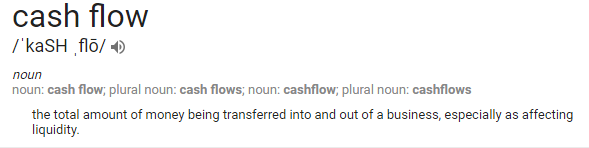
Cash Flow is the total amount of money coming into a business (revenue, income, investments, loans, etc.) and the total amount of money going out of a business (bills, expenses, wages, capital purchases, etc.) over a given period of time. It can be a year, a quarter, a month, or any time period you want to look at. For my purposes, monthly reporting is preferred, as it coincides with other regular monthly financial reports.

Doesn’t the profit & loss report show you the same information?

While reporting similar information, Cash Flow & Profit & Loss Reports serve different purposes. The Cash Flow report gives you an understanding of how you are bringing money into your business and how you are spending it while the P & L report shows you revenue earned and expenses paid.

OK, that still sounds similar, you say.

It may be easier to understand if you look at it from the perspective of different accounting methods. Businesses use either the Cash Basis or the Accrual Basis methods. 

"Cash basis - Revenue is recorded when cash is received from customers, and expenses are recorded when cash is paid to suppliers and employees.

Accrual basis - Revenue is recorded when earned and expenses are recorded when consumed."

If you are operating on the Cash Basis method, your revenue and expenses are recorded into your accounting system when they occur. In this case, your P & L and Cash Flow Reports should show almost the same information for a given period, with minor differences like loan principle repayments not showing up on a P & L.

In the case of the Accrual Method, you might earn revenue in a given month, but you won’t see the money from it until the invoice gets paid, which may be a month down the line. As for expenses, you may be paying for supplies immediately, but can’t show them on the P & L until the revenue is earned. So, you are potentially paying for supplies in one month, showing revenue in the next month, and not actually getting paid until the third month.  In this scenario, the P & L would show the expense & revenue in the second month, but the Cash Flow would show the outflow of the expense in the first month, no activity (with respect to the subject order) in the second month, and would show the revenue inflow (invoice being paid) in the third month.

Because of this, you should be looking at both reports to better understand what is going on in the business.

Why is Cash Flow important?

To be a successful business, you want to have positive cash flow…that means that you have more money coming in every month than you are paying out in expenses, wages, and bills. This seems like a “DUH!!!” statement, but without looking at both your P & L AND Cash Flow reports, it would be hard to make sure you are able to bring in more cash than pay out in expenses.

Without regularly reviewing the Cash Flow statement, you might think you are breaking even or close to it, until you realize that your bank account has steadily been dropping and you really were not even close to breaking even.


And, as always, let me know what you think in the comments. Ask questions, tell your story.


If you like my posts, please share them with others and subscribe to this blog.

Personal Finance: Saving Money Versus Saving Money Versus Saving Money

Saving Money...Maybe you should think of it as Rescuing Your Money!


This week I am going to cover saving money. There are many differing thoughts about this topic these days, some of which have valid points. I will also lay out my thoughts on the idea.

Saving Money – Why Should You?

Why should you save money? You can save money for an emergency. You can save money for to buy something special. You can save money for a dream vacation. You can save money for retirement. Your reasons are valid for you.

Tim Ferriss advises that you set dreamlines…goals you want to achieve and figure out how much it will cost, both per month and one-time charges, so you can figure out how to get your retirement now rather than delaying and saving for “one day”. There is also this whole part about coming up with a muse, or business idea that will provide the extra income to cover the costs of achieving that mini-retirement. The other thing is that they should be frequent.

Robert Kiyosaki says “Savers are Losers!”. His reasoning is that no matter how you are saving money, be it in a bank, in a Certificate of Deposit (CD), or in a pickle jar buried in the back yard, you are losing money, at least at this point in time, because of monetary inflation.
MonetaryInflation is an increase in the money supply which generally results in priceinflation.  This acts as a “hidden tax”on the consumers in that country and is the primary cause of price inflation.Monetary inflation is commonly referred to as the government “printingmoney” although the actual process is a bit more complex than just cranking upthe printing presses but the effects are essentially the same.As the money supply increases the currency loses its purchasing powerand the price of goods and services increases.”

Why under the mattress, In a savings account, or In a Certificate of Deposit Costs You Money

Currently the rate of inflation is approximately 2%. Based on the definition above, that means that your money loses 2% of its purchasing power. If your savings account is paying 0.25% interest rate, your money in that account is losing 1.75% with this rate of inflation. If your CD is paying 0.3%, you are losing 1.7%. And if you have it in a pickle jar, you are losing the full 2.0% of purchasing power by not doing anything with it.

Ultimately, as far as I am concerned, instead of just saving money, put your money to work in an investment that will earn you more than the rate of inflation. Historically, the S&P 500 has provided positive returns over the long term, but in some years, like 2008, it had a negative 37% yield.

Overall, accounting for inflation, the market seems to average about a 7% return, but you will be advised to leave your money in the market and let things work themselves out. We have money in the market in the form of traditional & Roth IRAs, regular managed investments, my 401k, and various individual stocks that I play with (not very much).

I, personally, don’t want to devote my time to attempt to master the market.

Why you should make your money work for you

We also are investing in real estate. So far, those investments are working out to about a 9% return. Real estate has many options from flipping, to buy and hold (rentals), to lending, to investing in notes (becoming the mortgage holder for other borrowers). As stated before, BiggerPockets is the best free education on real estate investing you can find.

Additionally, we invested in a high-end door manufacturing business. It is not currently providing a return on investment, but it is improving and still self-sustaining, in addition to providing me and my fellow investors with some of the best business management lessons we have ever run across.

The bottom line, make your money work. To paraphrase the old adage, if your money is not moving forward, it’s falling behind.


And, as always, let me know what you think in the comments. Ask questions, tell your story.


If you like my posts, please share them with others and subscribe to this blog.

Business Startup: 9 Tips for Starting a Small Business with Partners


Today we are going to talk about a very specific subject: Starting a small business with a partner or partners.

The generally understood definition by the United States government for a small business is a business that employs less than 500 people. There are financial considerations that also go along with that, but I am not going to attempt to touch on those here.

With this in mind, the concept of the US economy being powered by small business makes a lot more sense. A large majority of businesses are small businesses.

I would venture to say that there is a sizable portion of the population that if not already running a business, want to start one. Based on that, I am going to provide some tips to get started and hopefully avoid pitfalls that I have run across in my business dealings.

Partners

Select your partners well. This seems obvious, but you need to ensure that goals are aligned, that you want the same things for the business. Make sure that you can work with your partners. Make sure that your personalities do not clash. Make sure that all partners are able to understand viewpoints that are different from their own ideas and give them thoughtful consideration. Put a plan together for how you will proceed and have everyone sign off on it. Avoid partnerships where one or more partners are self-serving and attempt to obstruct ideas that do not favor them.

Duties

Define the duties of each partner for the business before investing any money, time, or effort. Agree on who does what and how it will be done. Have each partner provide a plan for how they will accomplish their duties. This seems a bit like overkill, but the effort put into this exercise will pay dividends in the form of getting each partner to think about what they will be doing and how they will be doing it. That alone is worth the exercise.

LLC or C-Corp

There are other types of legal entities, but this seems to be the most common structure used for small businesses. Depending on the type of business, you may be forced into using a C-Corp entity structure, such as a manufacturing business with inventory. While I am not an attorney and I do not play one on the internet, I am of the opinion that most small businesses are best served by an LLC structure.

In an LLC structure, the entity is considered a pass-through entity, so the profits of the company are passed through to the partners based on shares of equity in the company, to be reported on their personal income taxes.

With a C-Corp, the company is taxed, then dividends passed on to the shareholders (partners) is taxed again.

Operating Agreement

This is also a big one. The operating agreement can be based on the details pulled together in the Duties step. It just formalizes how the company will operate and documents the what & how for each partner. It also should contain exit strategies for each partner and for the company as a whole. This is probably more geared towards an LLC entity, but also has relevance to shareholders in a small private C-Corp.

Entity Name

If you already have a good idea for an entity name, then obviously, use it. But if you don’t, there is no need to stress out over it. Pick a name and as long as it is not already in use or trademarked, it will be good. If you later want have specific company branding/marketing, you can create a “Doing Business As” or DBA name. In most cases, all you have to do is file a form with the state for it to be recognized.

Employer Identification Number (EIN)

The Internal Revenue Service (IRS) uses the employer identification number or Tax ID as an identifier for businesses so they can track income and revenue. It costs nothing and can easily be applied for online.

Business License

Depending on the nature of your business, you may need to get a parish, county, or city business license. They are usually just a nominal fee, but not a whole lot. (Caveat: larger cities may have more exorbitant fees).

Business Bank Account

Always use a business bank account for your business finances. Keep your personal finances separate from your business finances. This will help to keep track of how well your business is doing.

Accounting

For accounting purposes, you can start out tracking everything in a spreadsheet. Document revenue, document expenses. Depending on the nature of the business, you may need to do a little more than that and use an accounting software program or service. Once you reach a level where revenue and cash flow allow it, accounting tasks can be delegated to a book keeper.

I would also like to recommend using a CPA for filing your taxes. Having a good CPA on board will keep you out of trouble. Especially if a partner decides it is someone else’s job to get all documentation to said CPA at tax time. The CPA will file an extension on your behalf to keep you out of trouble.


And, as always, let me know what you think in the comments. Ask questions, tell your story.


If you like my posts, please share them with others and subscribe to this blog.

REI – How We Found Our 2nd Property

Our Second Rental Property!
This week we are going to talk about how we found our second real estate investment property. If you have been playing along, you know that our first property was my wife’s inherited childhood home that we turned into a rental.

Because I work a full-time (+) job in addition to being a minority shareholder & director of a manufacturing business, I don’t have a marketing pipeline set up to find properties. That doesn’t mean I won’t ever have one, just that right now I am moving slowly. Mainly, my wife and I watch the MLS (via Zillow, Trulia, Realtor.com, and local real estate companies) for properties that fit our criteria. That criteria is three bedroom, two bathroom houses built on a slab foundation with central heating and cooling in decent neighborhoods. We have more or less decided to focus on the Thibodaux, La area, mainly because I am very familiar with Thibodaux and Nicholls State University is located there.

We noticed a price drop for a property just outside of the city limits of Thibodaux. It is about a 5-minute drive from the university. Initially, the property was listed at $120,000. I thought that was a little high for us to buy as an investment, so I did not pay much attention to it. The price drop was $40,000, so that was enough incentive for us to go check out the property.

In looking at the pictures on Zillow, I recognized the name of the listing agent from the sign in the yard. It was the same agent that acted as property manager when I was renting a house a block or so away from the subject property some twenty plus years ago. So, I emailed her to ask about a showing. We were able to go look at it and liked the structure. While there were some superficial repairs and painting needed, structurally, it was in good shape. We estimated that we could rehab it for approximately $20,000, with a $5,000 contingency budget in case we needed to do anything else.

Below are before pictures. More of the story after that.


We put in an offer of $72,581. It was accepted and had 10 days from their acceptance to perform due diligence on the property. We immediately lined up an inspection by our HVAC contractor and a certified home inspector, in addition to requesting an estimate from an electrical contractor.

The home inspector identified some issues with the electrical panel & feed lines and confirmed that the water damage to the ceiling tile was due to the air conditioning duct work sweating and leaking through.

The HVAC contractor identified that the furnace chamber had rusted out and the whole inside unit needed to be replaced. We had the option to replace the inside portion for $4,200 or the whole system for $5,700. If he would have to come back to replace the outside portion, it would be $2,000. We decided to wait on replacing the outside unit in the hopes that we could get another 2-3 years out of it. #ThereWentTheContingency

The electrical estimate came back at just under $2,000 to install GFCI outlets by the kitchen and bathroom sinks and to repair the panel/feed line issues, with $1,500 of it accounting for the panel/feed line issues.

I mentioned this fact to the real estate agent, who then got back with the seller and they responded with a counter offer of $71,000 for the home, basically negating the cost of repairing the panel/feed lines.

Next, I lined up a title company to close the transaction. Because the property was owned by 9 surviving heirs, it took a while for claims against the title to be researched. In addition to that, closing was delayed because one of the heirs owed child support and we had to get the district attorney to sign off on allowing the sale, as long as that heir’s proceeds were directed to monies owed.

We finally closed and began to work on the rehab. While waiting for closing, we identified a general contractor to change out doors, hang & finish drywall, and lay down new flooring and trim, among other things.

We handled painting, lighting fixtures, trim in the kitchen, and plumbing. The contractor handled everything else. It took us about 3 and a half months to finish everything and another 2 months to find the right tenants.

There were a couple of things that needed to be fixed after the tenants moved in, but it has now been six months since the lease started and everything is running smooth. The tenants are under a two year lease, so we have locked in cash flow through Q3 2019 for the property.

Because we purchased all cash, we have no debt service expenses. We may look at refinancing the property in the future, but I like the idea of cash flow because my goal is to get to the point where I can live just off of cash flow.

Numbers Breakdown

Purchase Price - $71,000
Rehab Costs - $20,637
ARV (After Repair Value) - $130,000
Annual Gross Rents - $11,100
CoC (Cash on Cash Return) – 5.38%
ROI – (Return on Investment) – 5.38%
Expenses - $4949
NOI - $5041
Debt Service - $0
Cash Flow-Annual - $5,041.22
Cash Flow-Monthly - $420.10
Cash Flow/Door-Monthly - $420.10

After pictures below:


And, as always, let me know what you think in the comments. Ask questions, tell your story.


If you like my posts, please share them with others and subscribe to this blog.

Personal Finance: What is an Asset?


Welcome back to the Things I Think About Blog. This week I am going to talk about what assets are, with regards to personal finance.

as·set /ˈaset/ noun
General Definition
a useful or valuable thing, person, or quality.
property owned by a person or company, regarded as having value and available to meet debts, commitments, or legacies.
military equipment, such as planes, ships, communications and radar installations, employed or targeted in military operations.
Accounting definition.
Things that are resources owned by a company and which have future economic value that can be measured and can be expressed in dollars. Examples include cash, investments, accounts receivable, inventory, supplies, land, buildings, equipment, and vehicles."

The definition we are going to focus on is “Property owned by a person or company…”.

Depending on how you look at things, you can call almost any property an asset. But the real question is will it make you profit? Does it earn you more money than it costs to keep it or can you sell it for  more than you paid or are paying for it?

A phrase you will hear people say is that “your home is your biggest asset”. It can be, but only in specific situations. You can have a large percentage of equity in your home, meaning the difference between what you home is worth versus what you owe on it, but you will only realize that equity if you either sell the property for a gain (if it has appreciated since you bought it), or if you refinance it and harvest the equity, then use that money to invest in something that will make you profit.

While I don’t have the numbers to back it up, I would bet that a lot of people are not in that situation.

Robert Kiyosaki even goes as far as to say that your home is never an asset because it is never bringing in cash flow. He makes the case that overall, you are better off renting and letting someone else worry about repairs, taxes, homeowner’s insurance, etc.

Personally, I tend to agree with him on that front, but I feel that if your goal is to own a home, then you figure out how to make that happen. Make investments that pay for the home you want.

Stay away from buying property that does not bring you profit…like boats, RVs, ATVs, etc. You do not need to spend all kinds of money on shiny objects, especially if they will not make you a profit.

While we are talking about assets or not assets, let’s look at buying a car. 
Here in the USA unless you live in a larger metropolitan area, you need a vehicle to get around. 
If you are in that situation, remember this interesting statistic, that new cars lose approximately 11% of its value. or what you paid for it, as soon as you drive it off of the lot.

Let’s look at this scenario, you buy a $25,000 car and you are able to get 1.9% financing through the dealership. Taking into account the “drive-off depreciation”, your first 8 car payments will be used to pay off that depreciation. Additionally, it will take another 6 months of payments to cover the rest of the first year of depreciation for that new vehicle.

You would be much better served buying a slightly used vehicle and saving the extra costs associated with buying a new one.

Invest in things that will make you money. Invest in things that provide cash flow. Don’t speculate on appreciation.

And, as always, let me know what you think in the comments. Ask questions, tell your story.


If you like my posts, please share them with others and subscribe to this blog.

REI – Analyzing a Property as a Rental


This week is a bit of a follow-up to last week’s article about finding your breakeven point. I covered what you needed to look at and why it was a good idea to know what your breakeven point was before you get into a business. Now I will apply similar principles to Real Estate Investing.

Today, I am going to go over what I look at when I evaluate a property to add to my portfolio. My strategy for real estate investing is Buy and Hold, meaning that I buy properties and intend to keep them long term, renting them out to tenants.

Cost Assumptions

For cost assumptions, I use the asking price, and an estimated cost of improvements (rehabbing property) & estimated closing costs (approximately 3% of price of property).


Finance Assumptions

Use a mortgage calculator to determine monthly debt service payment. Set the desired term (15 yrs, 20 yrs, 30 yrs, etc.), down payment, and interest rate.


Gross Rents

Gross Rents are the total rents expected to be collected on a monthly basis. This can be rent form a single-family home or a multi-family property such as a duplex, triplex, or larger apartment property.


Vacancy

To account for vacancy and deduct a percentage from your gross rent before deducting expenses. I generally use a conservative vacancy percentage like 10%. While I will more than likely not  have 10% vacancy in a year, accounting for it helps me to ensure the  property will always  cash flow.


Expenses

So, once I have a property to analyze, the first thing I do is verify the expenses. For the most part, the costs should be relatively the same, with the exception of property taxes. 
I account for the following expenses:

  • Property Taxes
  • Insurance
  • Maintenance & Repairs
  • Utilities
  • Advertising
  • Administrative
  • Variable Cost Property Management
  • Lawn Care / Landscaping
  • CAPEX


Property Taxes can usually be found on the local parish or county assessor’s website. You just have to search for the property address and all of the details for the property are listed. Who owns it, what municipal assessed value is, what the property has sold for, and what the city and parish/county taxes are estimated at for the current year.

Insurance can be estimated by getting a quote from your insurance agent/provider or if you have a similar property, you already have an idea what the cost is.

Maintenance & Repairs covers anything short of replacing major components of the property.
Utilities are what you expect to pay for utilities while doing turnover or when the property is unoccupied between tenants.

Advertising is the costs for paid advertising to attract tenants.

Administrative are the costs for anything administrative to do with operating the property as a rental. This covers book keeping, accounts payable, accounts receivable, etc.

Variable Cost Property Management is a percentage of gross rents paid to a property manager to manage the property. I account for this as an expense even though I manage my own properties so in the event I decide to engage a property manager, I already have that cost covered and don’t have to worry about adding a PM cutting into my cash flow.

Lawn Care/Landscaping covers grass-cutting when the property is not occupied and/or if the property is a multi-family property where the tenants don’t normally take care of the lawn.

CAPEX is an amount put aside to cover major repairs such as replacing the roof, appliances, flooring, plumbing, electrical, etc. That way, you have the money to cover these repairs instead of worrying where to get the money from.


The Analysis

Once I have gross rents, vacancy, cost assumptions, and expense values collected, then the analysis of the property can begin. I use a spreadsheet to conduct my analysis and it is set up to tell me what I need to know. There are inputs for all of the items listed so far.
I enter the asking price, my desired finance terms, estimated gross rents, and estimated expenses.
I then evaluate whether or not my targets are met at the property’s asking price. If it does not, I then start adjusting the price downward until I reach my target numbers.
For me to consider a property a good deal, it must meet the following criteria:
Cash flow >$100 per door and have >12% Cash on Cash Return, if financed
Cash flow >$400 per door and have >6% Cash on Cash Return, if purchased cash
Be in a decent neighborhood

Cash Flow
Cash Flow is the amount of money from gross rents (revenue) remaining after expenses and debt service are covered.
Cash on Cash Return 
Cash on Cash Return is the annual amount of return you get compared to the amount of cash you spent to acquire the property.


By comparing gross rents, total costs, expenses, debt service, and returns I am able to decide if a property will be a money-making addition to my portfolio. By continuing to add properties to my portfolio that cash flow, I get closer to my “Freedom Number”. Where my passive rental income covers my personal costs and expenses, so I don’t have to worry about needing a job.


And, as always, let me know what you think in the comments. Ask questions, tell your story.


If you like my posts, please share them with others and subscribe to this blog.

Business Finance: Knowing Your Costs or How to Find the Break-Even Point of Your Business


"The break-even point (BEP) in economicsbusiness—and specifically cost accounting—is the point at which total cost and total revenue are equal."

This week’s topic is knowing your costs for your business or the Break-Even Point (BEP).

Before starting a business (or buying one), you should understand what your Break Even Point is. The BEP is where you have enough revenue coming in to cover all of your expenses. It means $0 in profit, but also that all expenses are covered.

Knowing what your BEP is can be beneficial in evaluating how much of your product or service you will have to sell to begin generating profit. It is always better to have this information before engaging in a business rather than trying to figure it out after you are already involved.


Direct Expenses

When determining the BEP, there are some differences between how to calculate this information for a Service Business and a Manufactured Products Business.


  • Service Businesses are fairly easy in that you only need to tally up your direct expenses. This could be done on a monthly basis, but if you have expenses that come up at different times of the year, it is easier to estimate a total annual expense and divide it by 12 to give you a monthly expense amount. (At least that is what I have found when analyzing rental properties). 
  • Manufactured Products Businesses are slightly more complicated in that you need to understand what the Gross Profit (GP) on the products are. Gross Profit is the Total Sale Price minus the Cost Of Goods Sold (COGS – materials, labor to assemble). Once you know what your GP is, you will be able to calculate the BEP for the product.


Indirect Expenses


The next step is to gather all of your indirect expenses. This can include rent, utilities, sales, and distribution expenses. Anything that is not directly involved in the provision of a service or the manufacturing of a product.

Once you have all of your numbers, you can calculate your BEP.

For Service Businesses, your BEP is the sum of your direct and indirect expenses. If you bring in enough revenue to cover just those expenses, you have broken even.

For Manufactured Products Businesses, you simply divide your indirect expenses by your GP % to arrive at your BEP.

Example: Indirect Costs: $20,000; GP: 31%; $20,000/0.31= $64,516.13


As I stated above, it is a good idea to have this information before you are involved in a business. Once you understand where you stand with reference to a BEP, you can start to work on optimizing you costs & methodologies to increase efficiencies, lower costs, and lower the overall BEP for that business.


And, as always, let me know what you think in the comments. Ask questions, tell your story.


If you like my posts, please share them with others and subscribe to this blog.

Overspending, Why And What to Do about It


This week, we are going to talk about spending, spending habits, and debt. As I related in a couple of previous posts, My History With Money, Pt. I & My History With Money, Pt. II, I had a bit of a spending problem. While the majority of my debt was from my mortgage, I was having trouble keeping up with payments and just keeping cash on hand. Hopefully, I will be able to provide you with some insight into why we spend and get into debt.


First, here are some statistics I gathered on income and spending in the US:

  • The average pre-tax income for people living in the US in 2016 was just under $75,000.
  • The average annual expenditures for people living in the US in 2016, including food, housing, transportation, discretionary spending, and insurance was slightly over $57,000.
  • Add to that, the average amount of taxes paid between local, state, and federal in US as of last year is about $10,500.
  • What you wind up with is about $8,000 a year (or $666.67 per month) of savable/investable income, based on averages.

The problem with averages is that it smooths out all of the variations in the data. In simpler terms, not everybody can recognize that excess money at the end of the year.

Here’s another bothersome statistic: 43% of Americans in the US spend more money than they make, according to the Federal Reserve.


The most common reasons people spend more than they make.


How to address the reasons listed above

If you are in the situation where you are spending more than you make and/or are in a lot of debt, the first thing to do is commit to changing your habits and then doing some things to change your situation.

Budgeting:

Be aware of what money you have coming in and what money you are spending. Break out your spending between necessities and discretionary. Necessities are electricity, water, gas, mortgage/rent, food, transportation. Discretionary spending covers items like cell phones for every member of the family, cable, internet, visits to the casino, cigarettes, beer, and similar things that are not vital to your survival.

Figure out approximately what percentage of your monthly income is needed to cover each necessity and allocate a little more than that requirement to be put aside to cover each one. I suggest putting cash into envelopes labeled for each one. By putting a little more into the envelope, that will help to cover variances in income and costs. This idea is actually based on the ideas put forth in the book Profit First by Mike Michalowicz. The book is aimed at entrepreneurs trying to get their business to a profitable state, but the principles apply to personal finance, also.

They KEY thing is to not touch the money once you put it aside unless you are paying the bill it is dedicated to. 

Make sure you are also able to put aside an emergency fund. The amount should be approximately three times your monthly income/take home pay. This goes a long way towards keeping your life steady in the event of bad weather, vehicle breakdown, illness, etc.

Try to stick to only spending on necessities until you are comfortably out of debt. Then start looking for ways to invest some of your “profit” to make you more money. (Since I am not a financial advisor, I can’t offer advice on how to invest that money, but I will cover my thoughts on the matter in a future post.)

Credit cards: 

Only use them if you have the money to pay for what you are purchasing and can commit yourself to not spending the cash on anything other than paying your credit card bill.  If you have a balance on your credit card, don’t use it at all until the balance is paid off. Only then should you use a credit card to buy stuff.

If you already have a balance on your credit card or even multiple cards, work on paying off those balances first. There are two approaches to methodology when doing this, either start paying extra on the card with the highest interest rate and balance, if you can make yourself do that regularly without getting disappointed or pick a card with the smallest balance and pay it off first. This will give you a self-esteem boost by way of accomplishment.

DON’T PUT ANYTHING ELSE ON THAT CARD!

After the first one is paid off, take the monthly allotment of your income that was dedicated to paying off that card and start adding it to what you are paying on the next card. Keep doing that until all of your cards are paid off.

PAY OFF YOUR BALANCE EVERY MONTH!

This is crucial for not accumulating debt. It may even be better for you to have a charge card like American Express, where you are required to pay it off every month.

Don’t “float” your balance from one new card to another without paying it off. It ends badly.


Psychological Reasons for Spending


We are constantly being bombarded with advertising trying to influence us to spend money. Whether it is buy a new car, get the latest phone, or use our credit card to buy your dreams. Advertising implies that if we don’t spend, we are a lesser person. Don't believe it!

Yes, you do need some of the things you see advertised, but you don’t need to go broke or get in debt to get it.

Buying things to feel better about yourself actually make you feel worse in the long run.

DO something to change the things in your life you don’t like. Don’t waste time worrying about the things you can’t change, because it will only make you feel worse.


And, as always, let me know what you think in the comments. Ask questions, tell your story.


If you like my posts, please share them with others and subscribe to this blog.

Changing Platforms

Hey, this is just a short post to let you know that I am changing platforms for my blog. If you are looking for my latest posts, ...