Showing posts with label Making Money Work. Show all posts

Business Finance - Understanding Cash Flow

An infographic representation of Cash Flow.

Today I want to go over Cash Flow and why it is critical to business finance.

There are four basic reporting metrics for business finance:

  • Balance Sheet – Statement of financial position, reporting a company’s assets, liabilities, and owners’ equity at a given point in time.
  • Income Statement – Statement of revenue and expense or profit & loss.
  • Equity Statement – Statement of changes in equity or retained earnings.
  • Cash Flow Statement – Statement of a company’s cash inflows and outflows during a given period of time.


I will cover the first three in more detail with later posts because I want to talk about Cash Flow and the Cash Flow statement.
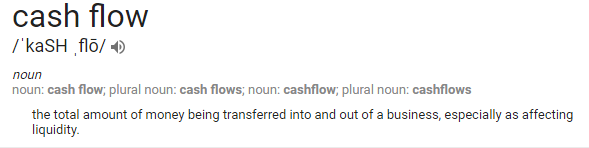


Cash Flow

Cash Flow is the total amount of money coming into a business (revenue, income, investments, loans, etc.) and the total amount of money going out of a business (bills, expenses, wages, capital purchases, etc.) over a given period of time. It can be a year, a quarter, a month, or any time period you want to look at. For my purposes, monthly reporting is preferred, as it coincides with other regular monthly financial reports.

Doesn’t the profit & loss report show you the same information?

While reporting similar information, Cash Flow & Profit & Loss Reports serve different purposes. The Cash Flow report gives you an understanding of how you are bringing money into your business and how you are spending it while the P & L report shows you revenue earned and expenses paid.

OK, that still sounds similar, you say.

It may be easier to understand if you look at it from the perspective of different accounting methods. Businesses use either the Cash Basis or the Accrual Basis methods. 

"Cash basis - Revenue is recorded when cash is received from customers, and expenses are recorded when cash is paid to suppliers and employees.

Accrual basis - Revenue is recorded when earned and expenses are recorded when consumed."

If you are operating on the Cash Basis method, your revenue and expenses are recorded into your accounting system when they occur. In this case, your P & L and Cash Flow Reports should show almost the same information for a given period, with minor differences like loan principle repayments not showing up on a P & L.

In the case of the Accrual Method, you might earn revenue in a given month, but you won’t see the money from it until the invoice gets paid, which may be a month down the line. As for expenses, you may be paying for supplies immediately, but can’t show them on the P & L until the revenue is earned. So, you are potentially paying for supplies in one month, showing revenue in the next month, and not actually getting paid until the third month.  In this scenario, the P & L would show the expense & revenue in the second month, but the Cash Flow would show the outflow of the expense in the first month, no activity (with respect to the subject order) in the second month, and would show the revenue inflow (invoice being paid) in the third month.

Because of this, you should be looking at both reports to better understand what is going on in the business.

Why is Cash Flow important?

To be a successful business, you want to have positive cash flow…that means that you have more money coming in every month than you are paying out in expenses, wages, and bills. This seems like a “DUH!!!” statement, but without looking at both your P & L AND Cash Flow reports, it would be hard to make sure you are able to bring in more cash than pay out in expenses.

Without regularly reviewing the Cash Flow statement, you might think you are breaking even or close to it, until you realize that your bank account has steadily been dropping and you really were not even close to breaking even.


And, as always, let me know what you think in the comments. Ask questions, tell your story.


If you like my posts, please share them with others and subscribe to this blog.

Personal Finance: Saving Money Versus Saving Money Versus Saving Money

Saving Money...Maybe you should think of it as Rescuing Your Money!


This week I am going to cover saving money. There are many differing thoughts about this topic these days, some of which have valid points. I will also lay out my thoughts on the idea.

Saving Money – Why Should You?

Why should you save money? You can save money for an emergency. You can save money for to buy something special. You can save money for a dream vacation. You can save money for retirement. Your reasons are valid for you.

Tim Ferriss advises that you set dreamlines…goals you want to achieve and figure out how much it will cost, both per month and one-time charges, so you can figure out how to get your retirement now rather than delaying and saving for “one day”. There is also this whole part about coming up with a muse, or business idea that will provide the extra income to cover the costs of achieving that mini-retirement. The other thing is that they should be frequent.

Robert Kiyosaki says “Savers are Losers!”. His reasoning is that no matter how you are saving money, be it in a bank, in a Certificate of Deposit (CD), or in a pickle jar buried in the back yard, you are losing money, at least at this point in time, because of monetary inflation.
“MonetaryInflation is an increase in the money supply which generally results in priceinflation.  This acts as a “hidden tax”on the consumers in that country and is the primary cause of price inflation.Monetary inflation is commonly referred to as the government “printingmoney” although the actual process is a bit more complex than just cranking upthe printing presses but the effects are essentially the same.As the money supply increases the currency loses its purchasing powerand the price of goods and services increases.”

Why under the mattress, In a savings account, or In a Certificate of Deposit Costs You Money

Currently the rate of inflation is approximately 2%. Based on the definition above, that means that your money loses 2% of its purchasing power. If your savings account is paying 0.25% interest rate, your money in that account is losing 1.75% with this rate of inflation. If your CD is paying 0.3%, you are losing 1.7%. And if you have it in a pickle jar, you are losing the full 2.0% of purchasing power by not doing anything with it.

Ultimately, as far as I am concerned, instead of just saving money, put your money to work in an investment that will earn you more than the rate of inflation. Historically, the S&P 500 has provided positive returns over the long term, but in some years, like 2008, it had a negative 37% yield.

Overall, accounting for inflation, the market seems to average about a 7% return, but you will be advised to leave your money in the market and let things work themselves out. We have money in the market in the form of traditional & Roth IRAs, regular managed investments, my 401k, and various individual stocks that I play with (not very much).

I, personally, don’t want to devote my time to attempt to master the market.

Why you should make your money work for you

We also are investing in real estate. So far, those investments are working out to about a 9% return. Real estate has many options from flipping, to buy and hold (rentals), to lending, to investing in notes (becoming the mortgage holder for other borrowers). As stated before, BiggerPockets is the best free education on real estate investing you can find.

Additionally, we invested in a high-end door manufacturing business. It is not currently providing a return on investment, but it is improving and still self-sustaining, in addition to providing me and my fellow investors with some of the best business management lessons we have ever run across.

The bottom line, make your money work. To paraphrase the old adage, if your money is not moving forward, it’s falling behind.


And, as always, let me know what you think in the comments. Ask questions, tell your story.


If you like my posts, please share them with others and subscribe to this blog.

Changing Platforms

Hey, this is just a short post to let you know that I am changing platforms for my blog. If you are looking for my latest posts, ...